Sound familiar?Cambridge
- The call
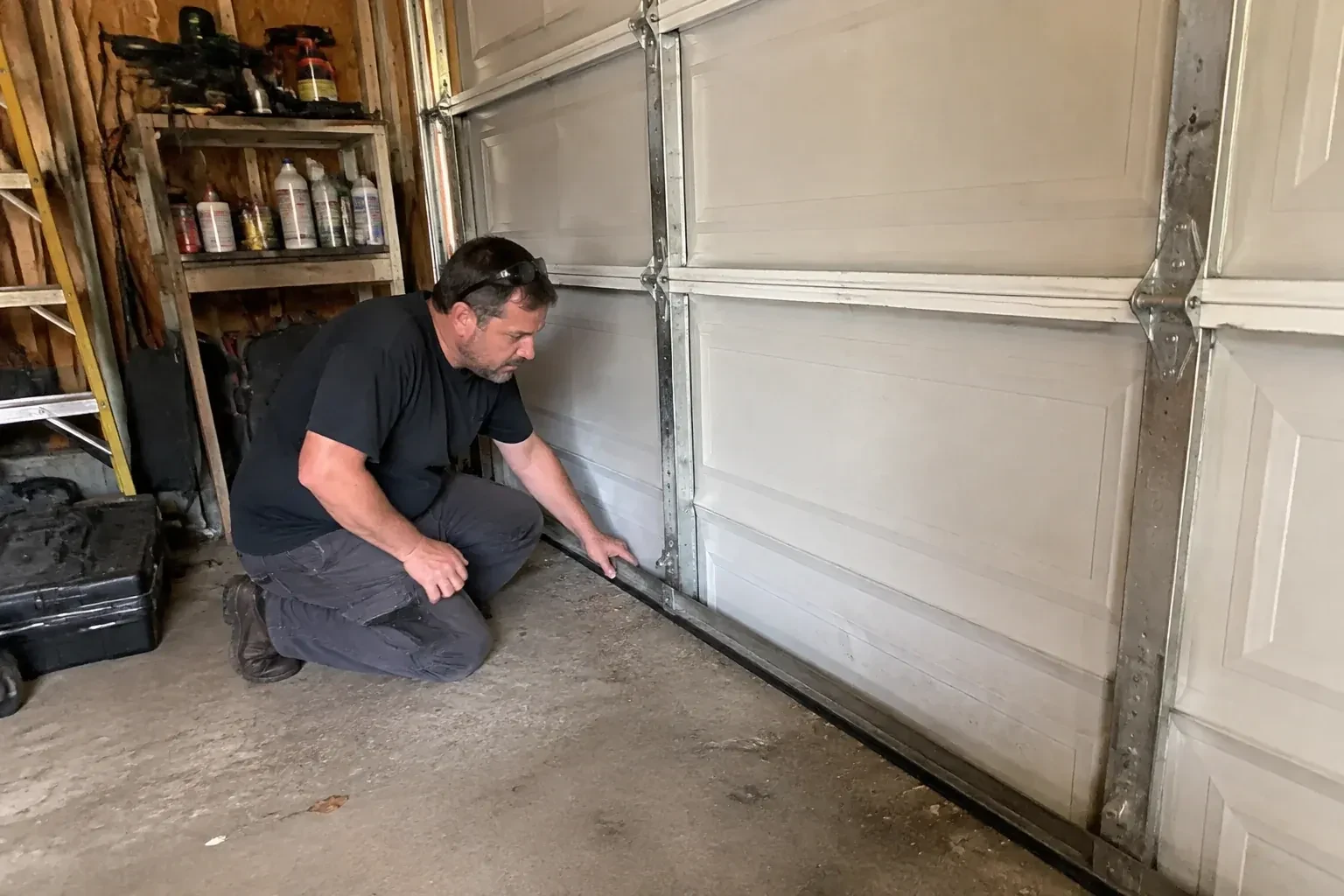
- The horizontal rail toward the back of the garage sags noticeably. The hanger that once held it to the ceiling swings on a single screw, and the open door drifts back down a few inches.
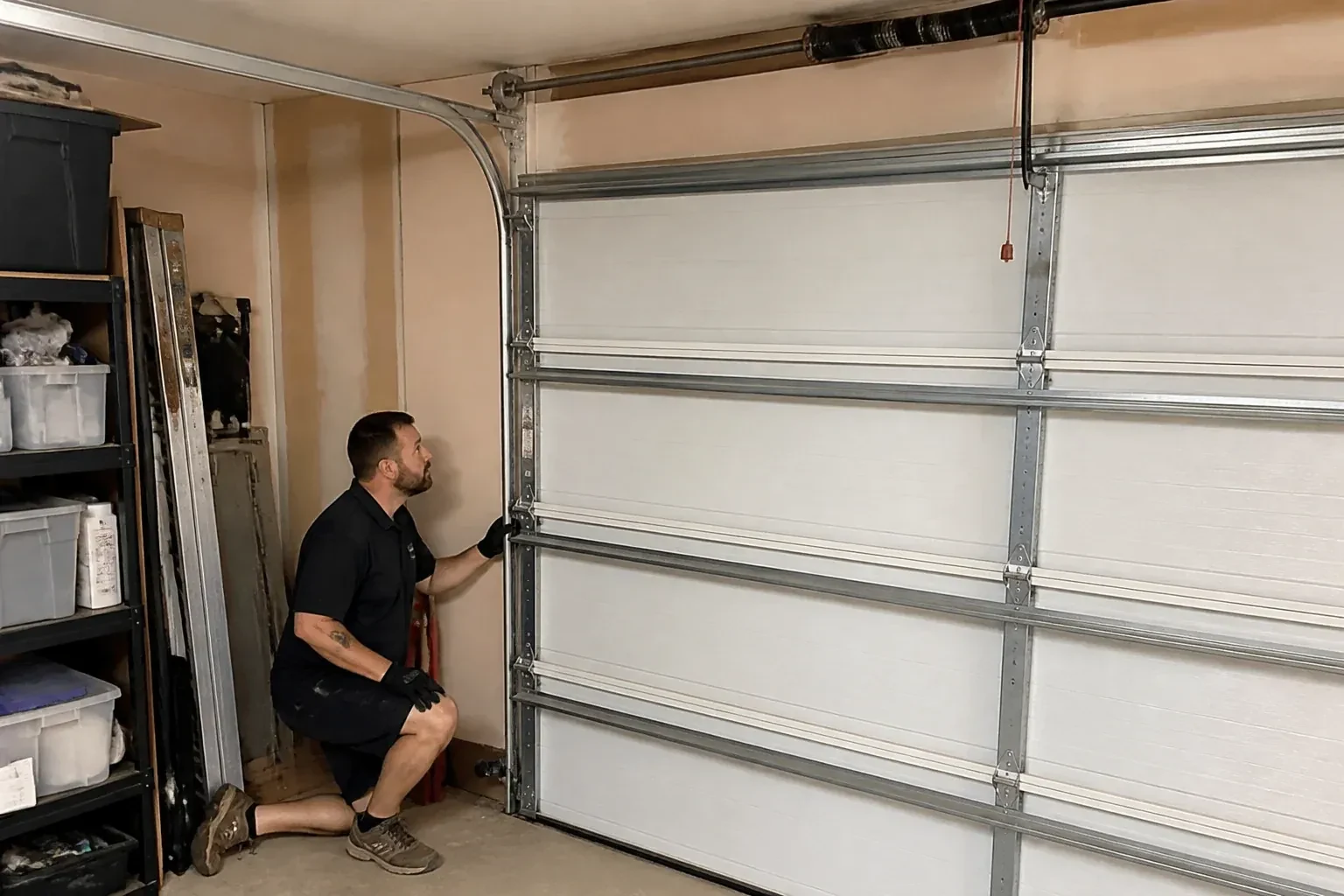
Vertical track is fixed to the jamb in one of two ways, and the assessment begins by reading which one your door has. Bracket-mounted track hangs on a few L-shaped jamb brackets, each lag-screwed into the wood, and can be shifted a little at each bracket to set spacing and plumb. Angle-mounted track uses a full-height continuous angle and is common where sideroom is tight. Either way the vertical run ends at a flag bracket that also carries the horizontal track and, on a torsion door, the spring shaft bearing. Track repair works with those fixings, tightening, replacing or repositioning them so the run sits true.
Sound familiar?Cambridge
Garage Door Track Repair or Replacement · Cambridge
Scene 1
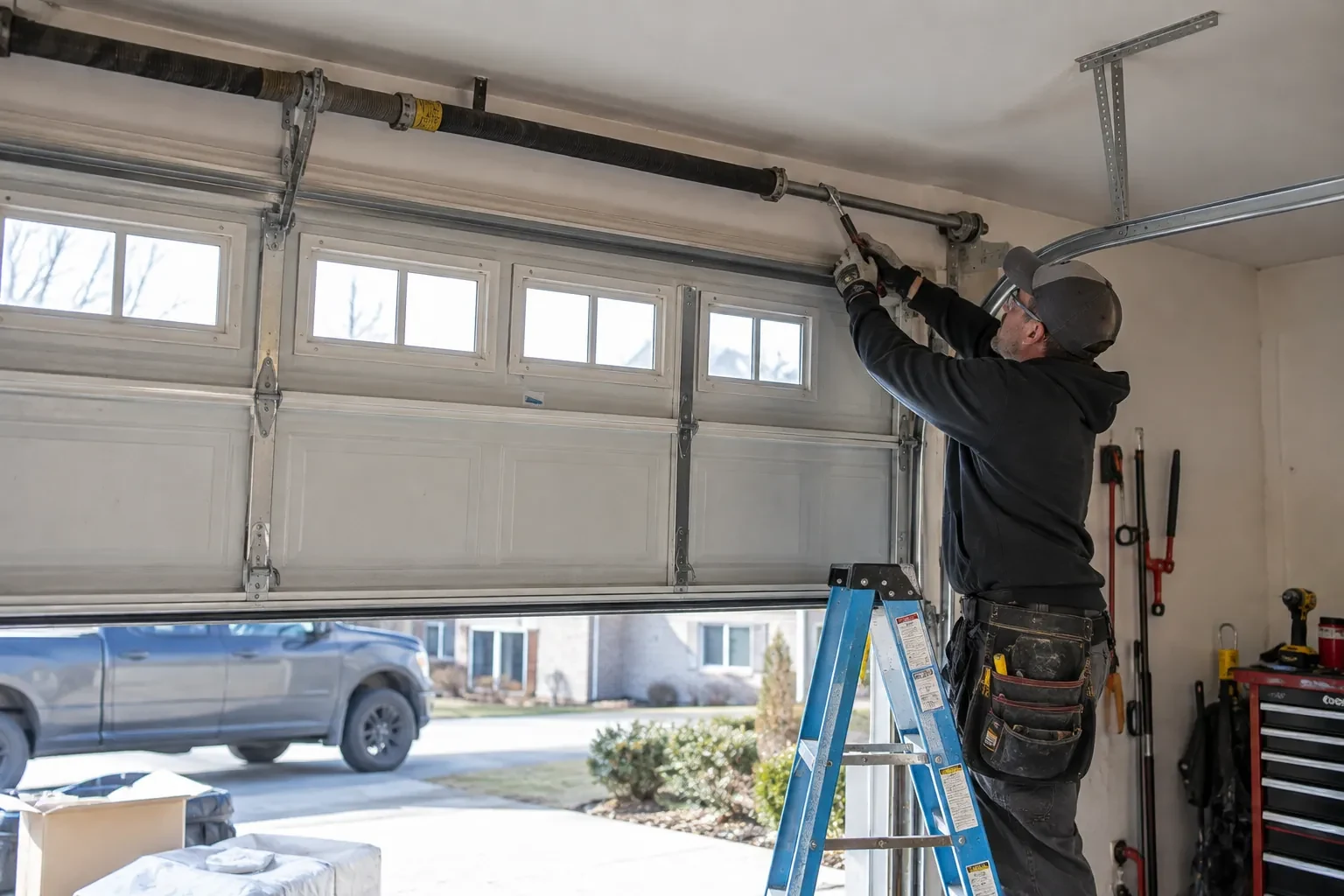
The curved piece where vertical meets horizontal takes the door's weight at the moment its direction changes, and it is the part least forgiving of a bend. The technician checks the curve for flattening, a twist or a kink, and confirms both sides share the same radius. Above it sits the flag bracket, the L-shaped angle that ties vertical track, horizontal track and, on a torsion door, the end bearing plate together. A loose or bent flag bracket shifts everything it holds, so its fasteners and squareness are checked with particular care, and the technician notes that the springs will be unloaded before that bracket is moved.
Scene 2
A shallow crease in the vertical run, clear of the curve, is repaired in place. With the door clamped and the nearest roller moved out of the way, the technician works the steel back to shape with track pliers, or with a hardwood block held inside the channel and a dead-blow hammer on the outside, taking small bites rather than one heavy blow so the metal returns without stretching. A spare roller is passed through the repaired length as a gauge: it should run freely with no tight spot and no rattle. If the crease has cracked the steel or left a ridge the roller still feels, the piece is scheduled for replacement instead.
Scene 3
Before leaving, the technician tells you what the door runs on: two-inch or three-inch track, the radius of the curve, whether the layout is standard, low-headroom or high lift, and which pieces were straightened or replaced. Write it inside the cover of the door manual or on a card by the opener. Any future part, a roller, a hinge, a section of track, is then ordered to match rather than measured from scratch, and a technician years from now can read at a glance how the door was set up. If the jamb was repaired or a hanger moved to a joist, that goes on the same note.
What shapes the quoteHespeler Door & Opener Co.
FeesSame any hour
Often, yes. The vertical track is meant to stand a fraction further from the jamb at the top than the bottom, so the closed door seals on its stop and swings clear as it rises. If a bracket has loosened or the track was set flat to the wood, the door drags along the stop moulding every trip. Resetting the spacing and taper, and tightening the brackets into sound wood, usually ends the rub.
Where the damage is, at floor level, near the curve or overhead; what caused it if you know, such as a bumper or a ladder; whether the door is closed, open or stuck partway; whether any roller has come out of the channel; whether there is a spring above the door or springs along the tracks; and the door's rough size. A photo of the damaged length and of a bracket with its screws is very useful.
A catch that repeats in one place is the signature of a local track fault: a dent, a spread section, a step at a joint, or a bracket that has let the track drift. Each roller reaches the flaw at the same point in the travel and bumps over it. The technician finds the spot by running a roller through the channel by hand, then dresses or replaces that length and checks the rest of the run for the same problem.
WaterlooOntario
Every square is one home in a hundred.
On-site assessment
Backing out this morning, the mirror caught the track beside the door.
(226) 887-1169, open 24/7.
On-site assessment preferred · (226) 887-1169, open 24/7